Hamburg charging infrastructure master plan First Hamburg charging infrastructure master plan
Project period: 08/2014 – 12/2025
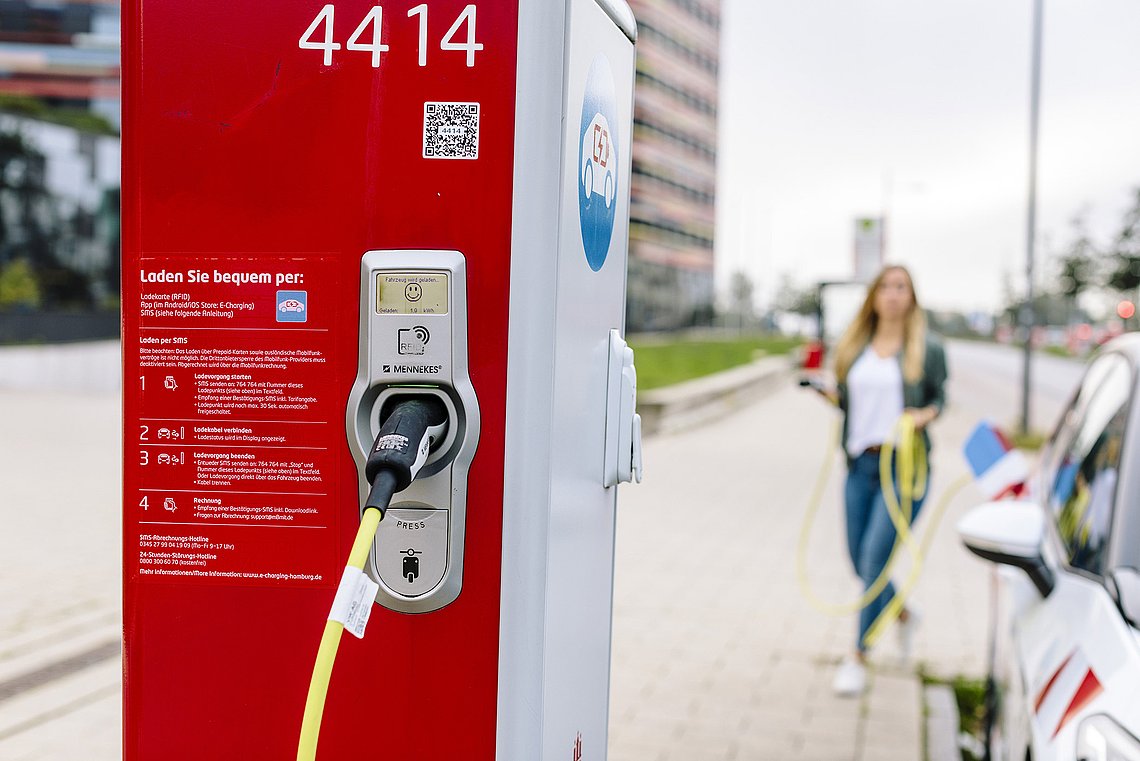
The aim is to establish a non-discriminatory, publicly accessible charging network for electric vehicles throughout Hamburg.
The goal of the master plan for the further development of publicly accessible charging infrastructure for electric vehicles in Hamburg (Senate Document 20/12811) is to enable non-discriminatory access to charging infrastructure for a growing number of users, while fully complying with the requirements set by the EU and the federal government, such as those regarding spontaneous access (ad hoc charging), . The master plan stipulated that at least 50% of the charging infrastructure on public land must be operated under public management.
Hamburg’s goal of creating a charging infrastructure offering that is well-received by users led to the definition of quality criteria for the implementation of public charging infrastructure, which became known as the Hamburg Model. Essentially, the Hamburg Model aims to make the charging infrastructure available to everyone without discrimination. Non-discrimination is an important principle not only for users but also for operators, as in addition to SNH, other infrastructure operators are to be integrated into the Hamburg concept, and various electricity providers (Electric Mobility Providers, EMPs) should also be able to offer their products at Hamburg’s charging stations.
When the master plan for public charging infrastructure was initially adopted in August 2014, the initial target was set at just under 600 charging points, of which just under 70 were to be DC fast chargers. This target was achieved in mid-2017, and a decision was made to expand the public charging infrastructure further to meet demand, reaching 1,000 charging points by the end of 2019.
As of September 2023, there are 750 charging stations in the city, providing a total of over 1,500 charging points. The vast majority of these are AC charging points with capacities of up to 22 kW. In addition, 24 DC charging points (up to 50 kW) and 24 HPC charging points (up to 150 kW) have been installed.
According to the current coalition agreement, expansion to a total of 2,000 charging points is planned by 2025. This expansion is to take place not only on public property but also on semi-public areas (e.g., company parking lots, etc.).