The North German hydrogen strategy On the way to a hydrogen economy
Project period: 01/2019 – 12/2030
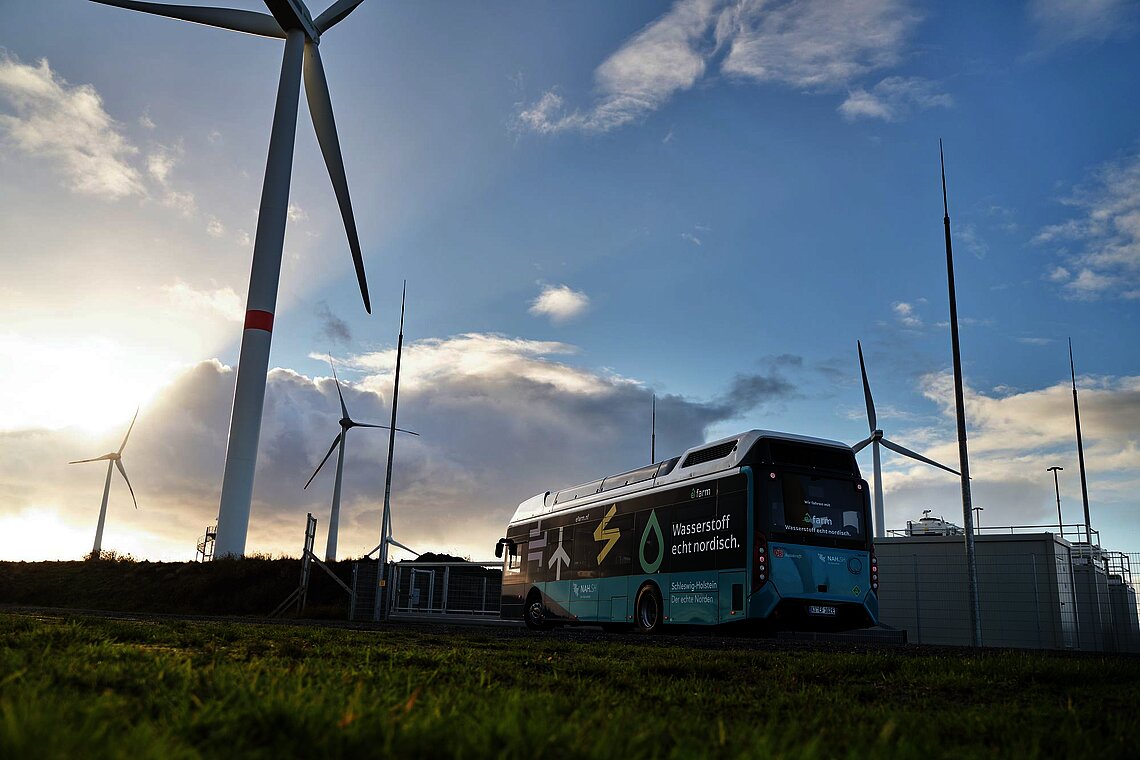
The North German Hydrogen Strategy has set itself the goal of establishing a self-sustaining hydrogen economy in northern Germany by 2035. The production, distribution and use of hydrogen will be bundled in several hydrogen hubs in northern Germany.
The North German Hydrogen Strategy is coordinated by the ministries of economic affairs and transportation of the five North German coastal states: Bremen, Hamburg, Mecklenburg-Western Pomerania, Lower Saxony, and Schleswig-Holstein.
Each of these coastal states is responsible for one of five action areas within the hydrogen strategy. Lower Saxony coordinates Action Area
1: Hydrogen Infrastructure. Schleswig-Holstein is responsible for Action Area 2: Value Creation through Hydrogen. Mecklenburg-Western Pomerania leads Action Area 3: Hydrogen in Policies, Approval Processes, and Programs. Bremen is working on Action Area 4: Hydrogen Acceptance and Education. Hamburg coordinates Action Area 5: Market Ramp-up. The five North German coastal states aim to leverage the unique locational advantages of Northern Germany to establish a self-sustaining hydrogen economy in Northern Germany by 2030.
These unique locational advantages include high generation capacities for onshore and offshore wind power with further expansion potential, underground formations for hydrogen storage, seaports that, as logistics and economic hubs, will play a key role in the future import and distribution of green hydrogen, and industrial sectors with significant experience in handling hydrogen. In addition, further expertise in the field of hydrogen is being developed in the North German real-world laboratories for the energy transition.
One of these real-world laboratories for the energy transition is the North German Real-World Laboratory (NRL), which is also managed by hysolutions. As part of the North German Hydrogen Strategy, at least 500 megawatts of electrolysis capacity for the production of green hydrogen is to be installed in Northern Germany by 2025, and at least five gigawatts by 2030. To achieve these goals, several hydrogen hubs have been established to centralize the production, distribution, and use of hydrogen, for example in the mobility and industrial sectors.
Project participants
- Lower Saxony Ministry of Economics, Labor, Transportation, and Digitalization
- Ministry of Economic Affairs, Transport, Labor, Technology, and Tourism of the State of Schleswig-Holstein
- Ministry of Energy, Infrastructure, and Digitalization of Mecklenburg-Western Pomerania
- Senator for Economic Affairs, Labor, and European Affairs of the Free Hanseatic City of Bremen
- Authority for Economic Affairs and Innovation of the Free and Hanseatic City of Hamburg